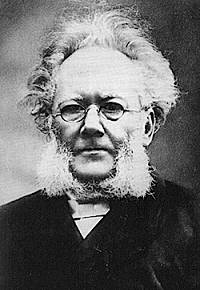
 Ibsen was born March 20, 1828, in Skien, Norway, a lumbering town south of Christiania, now Oslo. He was the second son in a wealthy family that included five other siblings. In 1835, financial problems forced the family to move to a smaller house in Venstop outside Skien. After eight years, the family moved back to Skein, and Ibsen moved to Grimstad to study as an apothecary's assistant. He applied to and was rejected at Christiania University. During the winter of 1848, Ibsen wrote his first play, Catiline, which was rejected by the Christiania Theatre; it was finally published in 1850 under the pseudonym Brynjolf Bjarme and generated little interest. Ibsen's second play, The Burial Mound, was also written under the pseudonym Brynjolf Bjarme and became the first Ibsen play to be performed when it was presented on September 26, 1850, at the Christiania Theatre.
 In 1851, Ibsen accepted an appointment as an assistant stage manager at the Norwegian Theatre in Bergen. He was also expected to assist the theatre as a dramatic author, and during his tenure at Bergen, Ibsen wrote Lady lnger (1855), The Feast at Solhoug (1856), and Olaf Liljekrans (1857). These early plays were written in verse and drawn from Norse folklore and myths. In 1857, Ibsen was released from his contract at Bergen and accepted a position at the Norwegian Theatre in Christiania. While there, Ibsen published The Vikings at Helgeland and married Suzannah Thoresen in 1858. The couple's only child, Sigurd, was born the following year.
By 1860, Ibsen was under attack in the press for a lack of productivity—although he had published a few poems during this period. When the Christiania Theatre went bankrupt in 1862, Ibsen was left with no regular income except a temporary position as a literary advisor to the reorganized Christiania Theatre. Due to a series of small government grants, by 1863 Ibsen was able to travel in Europe and begin what became an intense period of creativity. During this period, Ibsen completed The Pretenders (1863) and a dramatic epic poem, "Brand" (1866), which achieved critical notice; these works were soon followed by Peer Gynt (1867). The first of Ibsen's prose dramas, The League of Youth, published in 1869, was also the first of his plays to demonstrate a shift from an emphasis on plot to one of interpersonal relationships. This was followed by Emperor and Galilean (1873), Ibsen's first work to be translated into English, and Pillars of Society (1877). A Doll's House (1879), Ghosts (1881), and An Enemy of the People (1882) are among the last plays included in Ibsen's realism period. Ibsen continued to write of modern realistic themes in his next plays, but he also relied increasingly on metaphor and symbolism in The Wild Duck (1884) and Hedda Gabler (1890).
A shift from social concerns to the isolation of the individual marks the next phase of Ibsen's work. The Master Builder (1892), Little Eyolf (1894), John Gabriel Borkman (1896), and When We Dead Awaken (1899) all treat the conflicts that arise between art and life, between creativity and social expectations, and between personal contentment and self deception. These last works are considered by many critics to be autobiographical. In 1900, Ibsen suffered his first of several strokes. Ill health ended his writing career, and he died May 23, 1906.
Although Ibsen's audiences may have debated the social problems he depicted, modern critics are more often interested in the philosophical and psychological elements depicted in his plays and the ideological debates they generated. Source
